Wednesday, June 5, 2013

More delay on Hasan’s motion to continue


"You can't create an issue and then use the issue as a challenge for cause," Col. Tara Osborn admonishing Maj. Malik Hasan on rules of courts martial


Ft. Hood - Prosecutors and defense attorneys won’t find out until next Tuesday if the judge will give Maj. Abu Nidal Malik Hasan an additional 3 months to prepare his self defense for the murder of 13 fellow soldiers and the attempted premeditated murder of an additional 32 wounded on November 9, 2009.


Maj. Hasan has until 10:30 a.m. on Monday, June 10, to produce a supplemental statement of the facts in support of his motion to continue the case so he can revise his witness list in order to prepare a defense of acting to defend others’ lives against the intended hostilities of unarmed U.S. Army servicemen being readied at the Ft. Hood Soldier Readiness Center for deployment to Afghanistan.

Court will re-convene at 9 a.m. on Tuesday, June 11, so the judge can make her decision known.

The day’s proceedings regard a hearing to consider the continuance motion based on a defense strategy the former psychiatrist, a Palestinian-American and devout adherent to Islam, was attempting to save the lives of the leadership of the Taliban in the Emirate of Afghanistan.

The court session began a half hour late when Col. Tara Osborn dressed down the lead prosecutor because she did not get the government’s reply to Major Hasan’s brief until nearly half past 11 a.m. - just minutes before the scheduled time for the hearing.

“This is a court of law,” she said in a tired, matter-of-fact tone of voice. “I hve to consider with thoughtful deliberation...It’s obvious to me that both sides need more time to prepare.”

The lead prosecutor bounded to his feet, saying, “Your honor, we sent those to you at 10:22 a.m...The transmission across post is the problem.” He said he thinks there may be some confusion over the difference between eastern standard time and central time.

“I think we have gotten the cart before the horse,” the judge replied. She announced her finding that Maj. Hasan does not have the tools in place to prepare his proffer of motions he has made; and secondly, there is ample confusion among the three defense attorneys he dismissed as to the scope of their role as standby counsel.

There followed a lengthy, rambling discussion about the unavailability of internet access at the Bell County Justice Center, a hurdle that the judge told the lead defense lawyer, Col. Poppe, he and his two other colleagues will just have to work to overcome.

She ordered the three to stay on the job after turning down a motion to withdraw as defense counsel by Col. Martin, who has been banished to the spectator seats on a motion to dismiss him from the case, even as a standby counsel.

The three defense lawyers expressed a gloomy outlook as to what the licensing authorities in the three separate states where they have been admitted to the bar will say about their providing legal advice to a client who has obtained a favorable ruling on a motion to release them from his case.

Considering the fact that the Major has changed his mind three times in the matter of defense counsel, the judge ordered them to stay on the job and find a way to work with the licensing authorities.

The Major first decided he did not wish to be represented by Col. Tom Galligan, a former judge of the Army’s Third Judicial Circuit. After obtaining the representation of Col. Poppe and his two colleagues, the judge pointed out, he changed his mind for the second time and made a motion to relieve them.

Upon her advice to retain them as standby counsel, he changed his mind for the third time and chose to have them serve as his standby counsel.

Col. Poppe continued to beseech the judge, saying that they need time to research the legal propriety of allowing a former client to obtain legal advice following their release.

He asked her to either modify or rescind her order.

The judge countered his argument by pointing out that paralegals and law students constantly perform legal research for clients of law offices with no repercussions.

“Your honor, we have a disagreement...When a paralegal or an intern provides legal research, it is given through an attorney who says, ‘This is it.’”

The judge further ordered defense counsel to provide her with assurance that Maj. Hasan has all legal materials necessary to conduct his own defense, including making arrangements to have internet access at a special office provided in a trailer adjacent to the courthouse and their assurance that they will bring hard copies of materials he cannot obtain at the jail due to the internet blackout policy there by the end of business hours today, Wednesday, June 5.

As visitors filed out of the courtroom, they were greeted with soldiers holding loaded M-16 assault rifles on one-point slings, at the ready, in case of any breach of security as they started their march back to the media staging area a half-mile distant.

Security tightened at Hasan court martial


Ft. Hood - If the public is unaware that the general court martial of Major Abu Nidal Malik Hasan is yet another evolution in the global war on terror - a war that is carried out by means of terror - the reporters and correspondents who are covering the daily proceedings should be.


Maj. Hasan is on trial for his life in the capital murder case stemming from the massacre of 13 unarmed soldiers and civilian workers at the Soldier Readiness Center on November 9, 2009. An additional 32 persons were injured in what has been charged as specifications of premeditated murder and attempted murder with a powerful handgun that shoots a round designed to pierce the kind of body armor worn by soldiers and policemen.  

Media representatives check in each morning at a local shopping plaza off post, where Army security personnel attached to the Public Affairs Office check and re-check their credentials from a previous registration and vetting process, then stamp a gate pass.

Arriving at the designated gate, the satellite trucks and car loads of print journalists show their passes and personal ID, and they are passed into the fort.

At the news media staging facility, they are again checked in, asked to initial each page of an agreement on ground rules laid down by the judge, and the wait begins until court time.

All access screening is scheduled a minimum of an hour and a half in advance. For instance, for a 9 a.m. court session, everyone must be in place and ready no later than 7.

Cell phones are not allowed inside the courtroom or the closed circuit television screening room. All travel around the post is possible only with uniformed escort.

For instance, all television crews are accompanied to the parking lot to do a stand-up advance story prior to the day’s courtroom session.

Those who are chosen to go into the courtroom are put through a magnetometer check for metal objects, marched about a half-mile to the courthouse door, where they again go through a magnetometer check for metal objects, and are passed into the courtroom after they deposit their phones with security guards.

The entrances to the courthouse are guarded by Hesco barriers placed tightly enough to bar all rifle and rocket attacks and a concentric ring of shipping containers stacked three high. Additional security is provided by concrete traffic barriers that require all vehicle traffic to zig zag in the route to the building.

Any infraction of the ground rules or the day’s instructions are grounds for expulsion for the remainder of the trial.

In case of serious infractions, according to officers in charge of media security, the judge could rule out media participation entirely, allowing only a small group of “pool” reporters into the courtroom or the closed circuit television viewing room who then agree to brief all other news media at the close of the day’s session.

Tuesday, June 4, 2013

'Defense of others' a shaky scheme, at best, for Hasan


QUESTION: CAN A PERSON DEFEND A THIRD PARTY?
ANSWER: YES. A PERSON MAY ACT IN DEFENSE OF ANOTHER, BUT MAY NOT USE
MORE FORCE THAN THE PERSON DEFENDED WAS LAWFULLY ENTITLED TO USE IN HIS
OWN DEFENSE RCM 916 (e) 5.

2. Use of nondeadly force. The elements here are: (1) that the accused apprehended, upon
reasonable grounds, that bodily harm was about to be inflicted wrongfully on him; and (2) that the
accused believed that the force used "was necessary for protection against bodily harm, provided that the
force used by the accused was less than force reasonably likely to produce death or grievous bodily
harm." RCM 916(e) (3) Self-defense, then, may be used against the lesser forms of assault. U.S. v.
Sawyer, 4 MJ 64 (CMA 1977).

causing the victim's death. (click here for a discussion of 'defense of others' as a defense) 

Ft. Hood – When his court martial for premeditated murder reconvenes today at noon, Major Abu Nidal Malik Hasan will be on the hot seat to explain his “defense of others” strategy in the murderous Nov. 9, 2009 assault that left 13 dead and 32 wounded at this sprawling military post.

Yesterday, on Tuesday, June 4, Major Hasan, a former Army psychiatrist, told Col. Tara Osborn, his judge, that he intended to defend the lives of the Mullah Omar, a leader of the Taliban in the Emirate of Afghanistan from troopers who were being readied to deploy to that troubled region.

He was also scheduled to deploy there, an assignment he loathed because of his deep religious commitments to the tenets of Islam and the jihadist regimen espoused by the Taliban. Their doctrine is to take the sword in one hand, the Quaran in the other, and give infidels the choice of conversion, a swift death, or the acceptance of a life of dhimmitude in which they may not own property, employ others, enter into contracts, vote or enjoy any of the benefits of full citizenship.

Judge Osborn was a pains to clarify his meaning. She elicited responses from him in which he affirmed that though his victims were in central Texas at a U.S. Army base, he took deadly aim with his Fabrique Nacional 5.7mm pistol and fired with an aim to kill them in defense of the lives of Mullah Omar and “a group of leaders of the Taliban in Afghanistan.”

The judge gave him 24 hours to write a “proffer” of the facts of the case relevant to his defense of others strategy after he at first demurred, saying he needed time to compose a response.

She remonstrated with him, reminding him that she had warned him on Monday, June 3, when she granted his motion to represent himself against the charges of premediated murder and attempted murder that all the same rules apply to him as they do to attorneys.

Hasan seeks to turn court martial into a show trial


24-hour delay for continuance hearing


Ft. Hood - Major Abu Nidal Malik Hasan and Col. Tara Osborn clashed repeatedly today in a hearing to examine a motion for three months’ continuance he filed as an initial act serving as his own lawyer.

The judge reacted with seeming incredulity when she asked him for a “proffer” - an offering of proof - to support his defense based on the defense of others as outlined in the Rules for Court Martial.

Citing a subsection of the rules that calls for an affirmative defense if an actor employs deadly force in the defense of others’ lives, Major Hasan told the judge that he was acting in defense of Omar, a leader of the Taliban in the Emirate of Afghanistan.

“Let me get this straight. The victims are members of the U.S. military. The Taliban are in Afghanistan,” Judge Osborn said, her voice rising in pitch, a note of incomprehension of what she was hearing.

“They’re part of the U.S. military, but they’re about to deploy to Afghanistan,” said Maj. Hasan.

“You believed the people you murdered were about to inflict death or bodily harm on the Taliban?”

“Yes.”

Moments later, he allowed that the attack on the Taliban is part of an ongoing program of hostilities between Taliban forces and U.S. military units.

“Where is that defense found in RCM 9? (Rules for Courts Martial )Take your time...”

He had initially demurred in his response, saying he needed time to prepare a written answer to the question, not reply in an “incoherent fashion, not in a chopped-up fashion.”

For the second time, the judge reacted with chagrin, saying what she was asking for was a rendition of “some of the facts that you should be aware of, having been involved in this case for years.”

She reminded him that the day previous, she had warned him that he would be held to the same rules as any other attorney in his arguments.

Maj. Hasan responded after a lengthy pause that it is found at RMC 916 (e) (5).

The judge gave him 24 hours to prepare his answer. Court will reconvene at noon on Wednesday.

She did give one hint that she is keeping open the option of continuing the prosecution, rather than granting a motion to delay for an additional 3 months.

Col. Osborn asked the lead prosecutor, “The panel (of prospective jurors) is not to arrive earlier than Monday. Is travel on Sunday an issue?”

He said no.

Glimpses of Hasan emerge in court testimony


Ft. Hood - A picture of how Major Abu Nidal Malik Hasan spends his days isolated in an intensive care facility in the Bell County jail is beginning to emerge in court testimony.


The former Army psychiatrist is paralyzed from the chest down following a murderous rampage in November 2009 in which he assaulted dozens of defenseless fellow soldiers and civilian workers in a handgun assault at this post, just days prior to his planned deployment in Afghanistan.

A devout Muslim converted to the jihad cause by internet connections he made following his education and residency in psychiatry, he shouted - in Arabic - “God is good!” as he brutally murdered 13 persons and wounded an additional 32 with a powerful handgun round designed to pierce body armor of the type worn by police officers and soldiers, the Herstal 5.7 mm x 27 mm. A police officer’s bullet injured his spine. He spent months in the Brooke Army Hospital’s intensive care unit, where he convalesced from his injuries.

According to the testimony of a doctor who specializes in rehabilitative medicine, he moves his bowels each day at 8:30 p.m. with the aid of a special massage technique that stimulates the paralyzed abdominal muscles of his body. He reads the Quran, prays, and spends his time reclining in a hospital bed where he reads material supplied by either jail staff or his attorneys..  

He dresses himself after first climbing out of bed with the assistance of hand rails specially installed for the purpose. Once he has performed certain chores involving personal hygiene, he climbs back into the sack, where he dons special underclothing, his uniform, and boots.

Reveille comes at 4:30 a.m. for the Major when jailers feed the prisoners. Lunch is served at 10:30 and supper at 4:30. “However, I fast extensively.”

After his evening meal, “I pray and go to bed.” There is no enforced bed time in the county lockup.

Asked if he is ever released from the confines of the cell, he replied that during contact visits with family members and attorneys, he is released, but, “Other than that, I stay in my cell.”

According to the judge’s instructions in a previous hearing, Major Hasan will not be allowed to make speeches of a religious or political nature.

Sometimes, actions speak louder than words.

In a previous hearing, he managed to have two of his attorneys banished to the spectator seats, disallowed their previous places at the defense table. Only the lead counsel will be allowed to sit at his side to offer legal advice on procedural matters, such as when to object to various lines of testimony and evidence in order to preserve a record of possible judicial error and a subsequent appeal.

He offered no reason for his objections to the other two attorneys.

Today’s hearing, held on a morning when sunrise came as a crescent moon glowed brightly at meridian height, is being held to consider a 3-month delay to his trial in order to adjust his defense strategy according to others’ help. It is unclear if this will be further explained in the ensuing dialogue.

The Major also wishes to add additional names to his witness list.

Flashing blue lights and sirens accompany the Major’s arrival on post each morning as a convoy of anonymous white vans and police cars speeds up to the main gate from Texas Highway 190, circles around his former duty station at Darnall Army Hospital, and winds through a residential neighborhood on post to the courthouse, where he is transported into the courtroom in his manual wheelchair.

The Major’s facial features appear sallow and gaunt, dominated by a busy, untrimmed beard protruding from his face and neck without any discernible trimmed shape.  His body appears bloated under his camouflage fatigues.

Controversy surrounding this beard delayed the trial for several months as the former judge - who was relieved following an appeal to a higher military tribunal - took a hard line and refused to allow the proceedings to take place until the Major complied with Army regulations and shaved himself.

The appeals court declared the matter of little importance and ordered the trial to proceed. At that time, Col. Tara Osborn took the bench as the trial judge in the matter.  

Monday, June 3, 2013

Judge rules Hasan to defend himself at trial


BULLETIN: Major Hasan requested an additional 3-month continuance in his trial to develop a new defense strategy. The judge scheduled another pre-trial hearing on Tuesday at 9 a.m. to hear the motion...

Ft. Hood - Major Abu Nidal Malik Hasan will represent himself, the judge ruled today.

The former Army psychiatrist is accused of 13 specifications of premeditated murder and 32 counts of attempted premeditated murder. He is paralyzed from the chest down following his November, 2009 rampage at the Soldier Readiness Center.


Col. Tara Osborn ordered a physical examination to determine if the Major is able to withstand the rigors of directing his defense. 

According to an Army doctor from Ft. Sam Houston, Maj. Prasad Lakshminarasimhiah whose Hindu name is so long and difficult to pronounce he advised her to just call him “Doctor L” for short, the defendant is capable of sitting upright in his wheelchair for periods of up to 12 hours, as long as he is allowed to relieve the pressure on his buttocks and to stretch every 2 to 4 hours.


The doctor testified that the Major’s prognosis for recovery is “way poor,” and that he has almost no use of his left hand due to nerve damage, and some impairment in his right hand.


“One of the main things a lawyer has to do is write,” said the judge. “One of the ways this court operates - or any court, for that matter - is to submit documents,” the judge said. “Knowing this, how will you do this?”


The Major replied that he will do “The best I can.”


She found no reason he is not mentally capable of the task at hand.


“I think it is unwise for you to represent yourself,” the judge said, as she granted his motion to waive counsel.


The Major followed her recommendation that he allow his defense team to sit at the table during the trial, standing  by to answer questions on procedure and law, with the exception of Col. Martin.”


The Major gave no reason as to his objection, saying only, “I prefer for Col. Martin not to be on the team at all.”


He told the judge he is under no pressure or threat to waive his rights to legal counsel, and that if he is disqualified due to misconduct or incompetence, he will be represented by the Army officers who have been representing him.

Col. Osborn pointed to a thick red manual on the counsel table. She asked Maj. Hasan if he is aware that all the military rules of criminal evidence, the rules of courts martial, criminal procedure, and appeals are contained between its covers.

He said yes. She asked if he has had any legal training in all his years of education. He said no.

In finding his motion to be “knowing and intelligent,” she cautioned the Major that if improper evidence is entered into the record without his objection, he will be responsible for the effort to appeal the error.

“I can only accept the motion for waiver of legal counsel if I find you are competent and recognize the disadvantages.”

She cited a 1975 Supreme Court case in which the high court held that all defendants have the legal right to conduct their own defense if they are mentally and physically competent to do so, and recognize the risks associated with this.

Col. Osborn asked Major Hasan if he knew that the lead prosecutor has more than 20 years of experience with capital cases and a long record of convictions of those so accused.

“I’m going to do the best I can do,” he assured her.

She asked him to look at the charging instrument from his case file.

“How many counts are you charged with?” she asked.  He took his time and answered, “Thirteen counts of premeditated murder.”

She asked what else is he charged with.

In that interchange, he was silent for a long time before he replied, “Thirty-two counts of premeditated attempted murder.”

The judge asked what does a capital case mean.

“The death penalty.”

“These are lawyers who specialize in these types of cases,” she said, “and you want to waive your right to be represented by them?”

“Yes, ma’am.”

In closing, Col. Osborn said, “The same rules that apply to your lawyers apply to you.”

She was silent for a moment, then said, “Do you understand, Major Hasan, that you would be better off with a trial lawyer?"
 
“I understand the Court considers ineffectivity of counsel.”
he replied.

Jury selection will begin on June 5 with a trial date of July 1.

Saturday, June 1, 2013

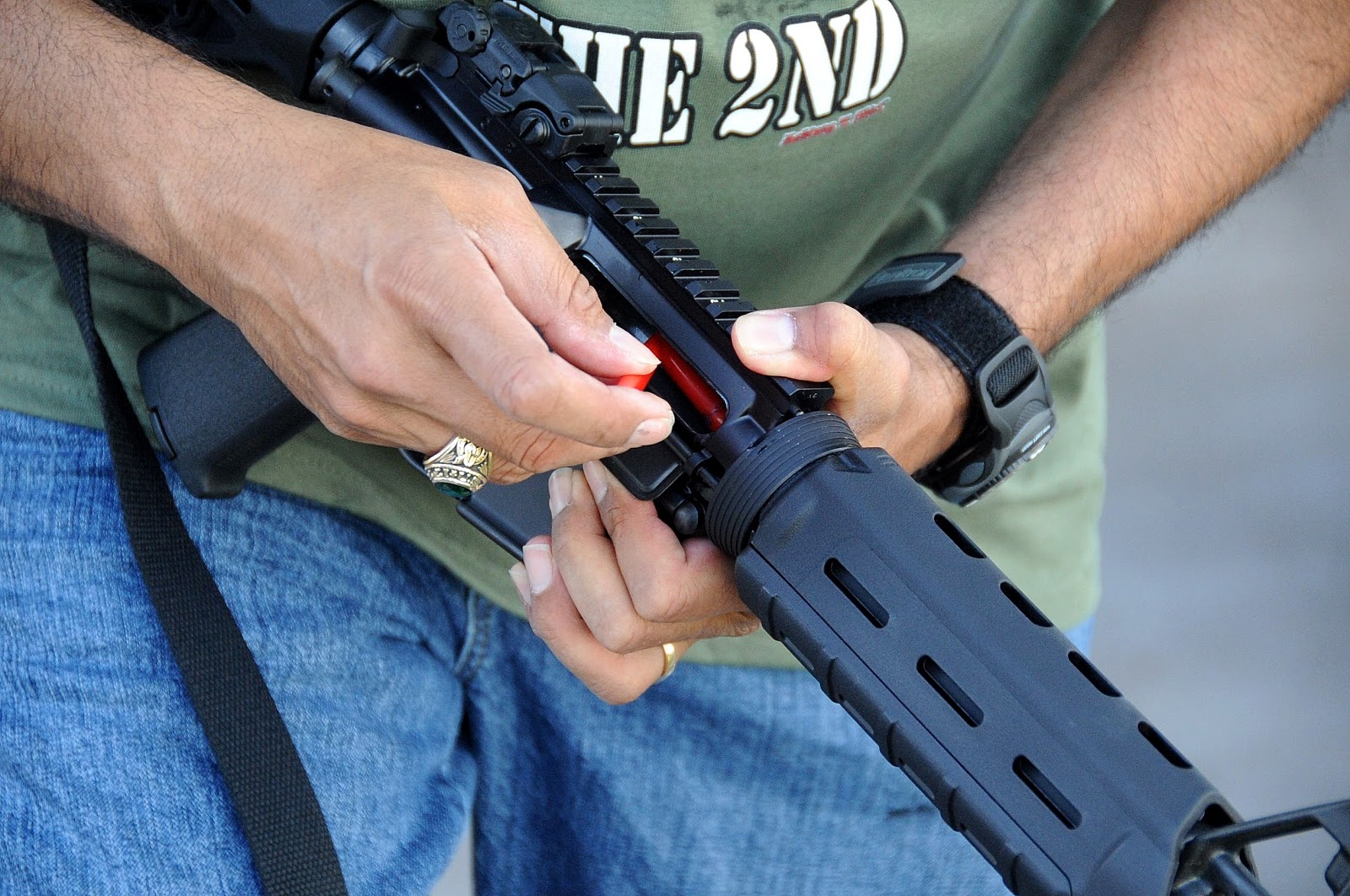
Open carry A-OK in Temple as Oathkeepers march


Temple – As the armed citizens assembled down by the tracks, near the old depot, experienced riflemen met them with “straws” - safety devices – to insert in the firing chambers of their weapons.

A standard practice among Army and Marine marksmen behind the firing line, it's considered essential at shooting matches and gun shows everywhere.


According to the event's key organizers, those who objected could have been expelled by cooperative Temple police officers, but no one seemed to mind.

When Master Sergeant C.J. Grisham took the podium, he praised the police department amid scattered boos and cat calls. He said it's like the Army, where he has served for 19 years on multiple deployments overseas. There are bad people everywhere.

One thing that disturbs him is that he has heard the three officers who arrested him on March 16 as he walked down a country road with a locked and loaded AR-15 assault rifle have suffered death threats.

He says he really doesn't think any human being deserves to have his or her life threatened just because they made a mistake.


It's all part of the Oath Keepers philosophy, he explained.

When he took the oath as an enlisted man in the U.S. Armed Forces, he swore he would uphold and defend the Constitution against all enemies, foreign and domestic.

He doesn't aim to go back on that oath.

About 200 persons attended, most of them bearing long guns at sling in the sunshine for a 15-block march that circled the police department and the major power centers of the city.

Though he has the right to keep and bear arms, said Sgt. Grisham, police arrested him and confiscated his weapons.

“Court is not the place to defend your rights,” he concluded. That struggle should take place “every minute of every day.”